The second volume of Justice S N Aggarwal's study of Sardar Patel's unification work turns to the questions that Volume 1 left open: the northeast, the privy purse, and the Hyderabad operation in full detail. These were not clean administrative matters — they were fought over at every level, and Patel's concern that the princely states would be denied constitutional protections (a concern Indira Gandhi vindicated by abolishing the privy purse in the early 1970s) runs through the narrative as a warning about what was at stake.
Aggarwal draws on official documents, quoting many verbatim, to build arguments with the precision his legal background demands. The book traces how Patel managed the northeastern states — where the diversity of political arrangements made the task far more complex than the accessions in the rest of the country — and why the Hyderabad episode, often reduced to a military police action, was considerably more fraught in its politics.
For researchers and students seeking primary-document grounding, or for anyone who wants to understand what chakravartin means applied to a democratic statesman, this volume completes the picture.
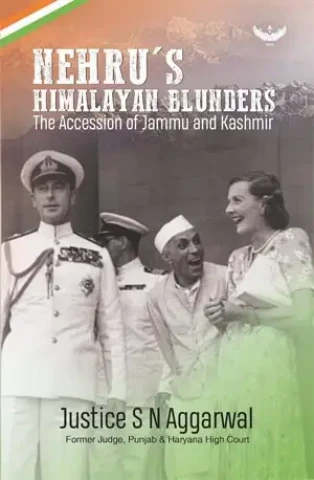
How many of us really know how the issues related to North-Eastern states were handled? Or, for that matter, what was Privy Purse for the princely states? Why Sardar was worried that they were attempts not to grant them Constitutional status (Indira Gandhi got it abolished in the early 1970s)? Further, this book sheds special light on how the Hyderabad episode was handled. Coming from a former Judge, also the author of “Nehru’s Himalayan Blunders”, the book provides to-the-point arguments based on official documents, a large number of which have been quoted verbatim. For those who wanted to know anything about the humongous effort of Sardar in unifying India, be it a student or a researcher or just anyone wanting to more about one’s own country, this book is a real eye-opener. We all know that India has existed thousands and thousands of years before 1947. But, had Sardar been the king of yesteryears, he could well have been known as the ‘chakravartin’, who brought entire India under one umbrella – that is the Indian union. Read this book know how he achieved that feat - democratically.