Aurangzeb's Iconoclasm

byFrancois Gautier

Illustrations from Primary Source

Aurangzeb's own court bulletins from Rajasthan State Archives document his temple destruction orders — illustrated with miniature paintings from the originals.

Overview

The debate over whether the Gyanvapi Masjid stands on the site of the Kashi Vishwanath temple has generated enormous heat and very little primary evidence — until now. Francois Gautier's Aurangzeb's Iconoclasm answers the question by going to the source: Emperor Aurangzeb's own court bulletins, the Akhbarat, preserved in the Rajasthan State Archives at Bikaner.

Those documents record temple destruction orders, restrictions on Hindu festivals, and incentives offered for the conversion of Hindus — not as inferences drawn from later histories but as contemporaneous administrative records. Gautier supplements them with credible Persian works and with miniature-style paintings, many reproduced from originals held in state archives and now part of the permanent collection at the Chhatrapati Shivaji Maharaj Museum of Indian History in Pune, which he founded.

The result is a visually illustrated evidentiary record rather than a polemical argument. Aurangzeb's court described what it was doing. This book lets those descriptions speak.

Based on Emperor Aurangzeb's Court Bulletins (Akhbarat) from Rajasthan State Archives, Bikaner and credible Persian works, this book "Aurangzeb's Iconoclasm" features paintings, court orders and other such material to bring out the nature of reign that Aurangzeb had unleashed. Many of these paintings, reproduced masterfully in miniature style from original documents kept in the state archives. They are now part of permanent exhibition at Chhatrapati Shivaji Maharaj Museum of Indian History in Pune, set up by the author, Francois Gautier. Clearly answers the question on the destruction of the Kashi Vishwanath temple, on Aurangzeb's orders, the site of the current Gyanvapi Masjid.

Author

Francois Gautier photo
Francois Gautier

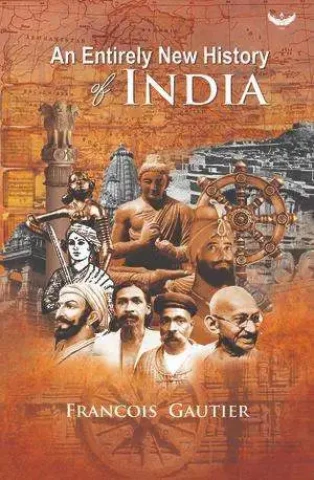
Franois Gautier F ranois Gautier was born in Paris, France. He was South Asia correspondent for Le Figaro, one of France's leading newspapers He also wrote columns for Indian newspapers: the 'Ferengi's column" in the Indian Express, then the "French Connection" column in the Pioneer, as well as regular contributions for Rediff., New Indian Express, Times of India blogs, etc. Franois has written several books - amongst the latest : An Entirely New History of India (Garuda Prakashan, 2021), The Art of Healing (Harper Collins, 2011), Quand l'Inde s'eveille, la France est endormie (Editions du Rocher, 2013), " Apprendre Souffler (Hachette Marabout, 2016) & " Nouvelle Histoire de l'Inde " (Editions de l'Archipel, 2017), " Les Mots du Dernier Dala-lama " (Flammarion, 2018), " In Defense of a Billion Hindus " (Har Anand, 2018) & " Hindu Power in the 21st Century " (Har Anand, 2019) Francois, who is married for 30 years to Namrita, shuttles between Pune and Delhi. He is building a Museum of (real) Indian History in Pune (factmuseum.com).

View Author Profile

WA