Sardar Vallabhbhai Patel unified more than five hundred princely states into the Indian Union in the months after independence — every one of them except the single princely state Jawaharlal Nehru insisted on handling himself: Jammu and Kashmir. That contrast is where Justice (retd.) S. N. Aggarwal begins, but the book does not stop at Kashmir.
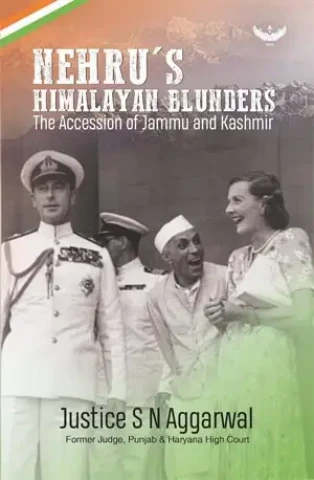
Aggarwal, also the author of Nehru's Himalayan Blunders, draws on authenticated sources to reconstruct what Patel's priorities were — defence preparedness, the primacy of patriotism and discipline in governance, and a determination to address India's vulnerabilities before they became crises. The book's argument is that these were not abstractions: they were practical commitments whose absence under Nehru's leadership produced specific, measurable consequences. The Iron Man's handling of Hyderabad, Junagadh, and five hundred other negotiations is set against Nehru's conduct in Kashmir to make the comparison concrete.
The book speaks to a persistent current in Indian political feeling — that the fork taken in 1947 matters because its effects have never fully resolved.
When a nation begins to pine for a person from its past, wishing he remained at the helm for longer, it indicates that the path taken by that nation is not the correct one. With Sardar Patel, especially vis-a-vis Nehru, the Indian nation still mourns the fact that the former did not become the first Prime Minister of India. This book, written by Justice (retd.) S N Aggarwal, author of “Nehru’s Himalayan Blunders”, establishes the real reasons why we still pine for Patel’s longer presence at the horizon of our national leadership. The book, quoting from authentic sources, also gives ample insight into the views and understanding of the affairs of the nation, which Sardar not only preached but also practiced. Usually, Sardar Patel, the “Iron Man” that he was, is lauded for his role in the unification of post-independent India. With Nehru botching up the only princely state he handled – namely, Jammu and Kashmir – Patel’s contribution in unifying more than 500 princely states in the Indian union becomes all the more laudable. However, this book goes beyond. “Had Sardar Patel been the first Prime Minister, the country would have been fully armed to defend herself, there could have been no danger from outside. By following the principles of patriotism, moral values and high character and discipline, there would have been no internal problem,” writes the author. And, like the case of Kashmir, in these matters too, Nehru’s conduct makes one wish all the more strongly that Sardar should have been the first Prime Minister of India.