A king is cursed by an angry sage and reborn as an elephant. He leads his herd well and carries his devotion to Bhagwan Vishnu into his new form — until the day a giant crocodile seizes him in the water and his strength begins to fail. What follows is the Stuti, the prayer of absolute surrender, and Vishnu's descent to save him. It is one of the most celebrated episodes in the Puranas, and its power has always rested not in the spectacle of rescue but in the quality of the prayer that precedes it.
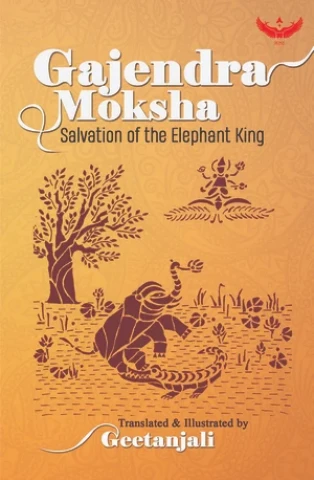
Geetanjali has retold this story in English verse — a form that allows the surrender at the story's heart to land with the weight it carries in the original. Alongside the poetry, she has incorporated Sanjhi art, a stencil-based visual tradition from Mathura that is itself endangered, giving the book a visual identity directly tied to the story's devotional geography.
For readers approaching the Puranas for the first time, this is an unusually accessible and beautiful entry point. For those already familiar with the story, the verse retelling and the Sanjhi illustrations offer something the prose versions do not.
Gajendra Moksha: Salvation of the Elephant King is a delightful rendition in English verses by Geetanjali, an upcoming artist and poet of a very famous story from the Puranas where a king is cursed by an angry sage to become an elephant. The good king, devoted to Bhagwan Vishnu, continues in his devotion and takes care of the herd, which he now heads as a king.
One day, a giant crocodile catches the elephant and he gets nearly killed. The elephant then remembers his Lord and sings his Stuti. Pleased with his devotion, Bhagwan Vishnu appears and saves him from the crocodile.
"While the story is engrossing...the emphasis is on the prayer that resides at its core....that embody an absolute surrender to the Divine," says Geetanjali.
In this work, Geetanjali has also used "Sanjhi art", a dying artform of Mathura, that uses stencilised cut-outs of the main characters to tell a story.
"Her love of the story shines through in her lyrical work...and her beautiful art adds a wonderfully unique visual appeal to her verse....," says
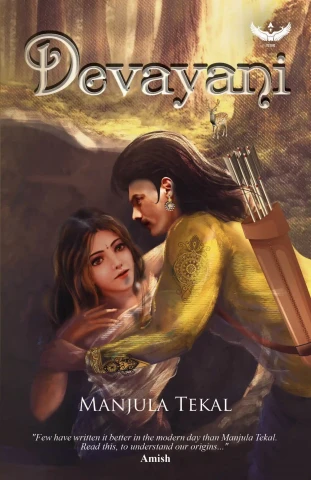
Manjula Tekal, Author,
Devayani.